


Smaller first project
Paddle Steamer Isabella 1912
- Skill
- Beginner
- Scale
- 1:60
- Length
- 420 mm
A paddle steamer of the kind that opened up inland Australia's rivers.
$287.00 AUD


Est.1986
1 / 6
Wooden model boat kit · 1:20
This James Caird model is a Beginner-level 1:20 wooden kit of Shackleton's lifeboat, 345 mm long (about 13.6 in). The hull is double planked and left open along the middle of each side to show the stores. She carries main and mizzen masts with calico sails you cut and stitch. We make the kit and sell it only here, so replacement parts and answers come straight from us.
Skill
Beginner
Finished length
345 mm
250 mm tall
Scale
1:20
Designed for a first build, with step-by-step colour photographs.
$330.00 AUD
In stock. Order today, dispatched next business day
Pay with Shop Pay, PayPal, Apple Pay, Google Pay or card
Buying it as a gift? Add a message in the cart. We ship worldwide; international import duties are paid on delivery unless checkout shows them included. Shipping details
You build the James Caird, one of the Endurance's lifeboats, as she was fitted out on the beach at Elephant Island for Sir Ernest Shackleton's crossing of the Southern Ocean to South Georgia. The wooden lifeboat you finish has the deck, rig and ballast added there, rather than the whaleboat as first built in London.
Between the upper and lower planks, the hull is left open along the middle of each side, so the frames, the stores and the ballast stay in view. Before the deck goes on, you fit a large and a small storage case, a cooking pot, a stove, a compass, two barrels and three sleeping bags.
The ballast comes in a bag. You stir it into water with a little white wood glue, then spoon it along the hull and let it set. The sleeping bags are cut from the calico, stiffened with diluted glue, rolled and tied with the supplied string, not sewn. Even the side benches are scribed with plank lines underneath, because that face can show through the opening.
On Elephant Island, the expedition's carpenter, Harry McNish, gave her a makeshift deck of wood and canvas, sealed with oil paint, lamp wick and seal blood. She was strengthened by having the Dudley Docker's mast lashed inside her, along the length of the keel. About a tonne of beach stones and shingle went in as ballast, to make her less likely to capsize.
On the model, box lids, sledge runners and spare boards go across the deck frames as the base, with a calico deck cover glued over them and hemmed round the cockpit. A 6 mm dowel, the hog-back, is shaped and glued along the keel. The instructions note it was fitted fore and aft to strengthen the keel against buckling in heavy seas.
The model is rigged as a ketch, like the real boat, with a 6 mm main mast and a 4 mm mizzen, two gaffs, a boom, and shrouds and stays in the supplied cord. The main, mizzen and jib sails are cut from the calico with printed templates and finished with a small tacking stitch. A pennant printed in the instructions flies at the main masthead. On the real boat it showed the wind direction, and the instructions name the James Caird Society at Dulwich College as their source for it.
The hull is double planked. A first layer of limewood strips is laid over the frames, then a thin second layer, mostly tanganika, goes on with contact glue. Laser-scored fairing lines on the key bulkheads show where to chamfer, so the planks sit flat. Like our other Beginner ship model kits, this kit comes as laser-cut parts you shape and fit.
You brush on white matt acrylic and rub it straight back with a damp cloth, coat after coat, then sand lightly and work tung oil into the bows and keel. The rudder gets the same, plus smears of green. You also trace the name onto each side of the bow through the supplied stencil.
Alongside white wood glue, the steps for this kit call for:
Read the building instructions before you buy (PDF, version 1.2)
What builders say
Modellers Shipyard 1:20 'James Caird' - This was such a lovely kit to build
An excellent product from Modellers Shipyard, quality materials, clear and well-written instructions.
This would be a good one to build with your kids that want to get into wooden ship/boats
It's simple ,small and appropriate for beginners :)
Very nice construction Manual!
The ship's story
October 1915
April 1916
1919
1922
Built by our customers
Real builds, shared online by the people who made them. Tap a photo to see it larger.


Finished, this model is 345 mm long and 250 mm tall at 1:20 scale. Measure your shelf or display case before you start.
Tools, glue and paint aren't in the box. Most builders work with:
All easy to find at a hobby or hardware store. Read through the instructions first so you know what each stage needs.
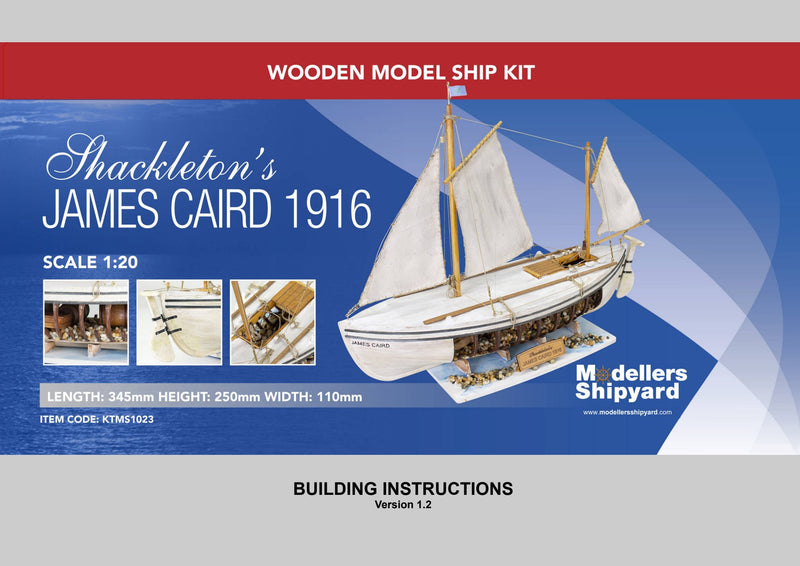
Every stage is photographed in full colour. Download the whole manual and see exactly what the build involves.
Before you buy
Still deciding?
Ask the people who design and make the kits. We'll tell you honestly which one suits your experience.
Ask us a questionEvery laser-cut part, all the timber, the rigging cord, a full set of fittings and A3 colour instructions are in the box. You'll need your own tools, glue and paint.
Yes. The full building instructions are a free PDF download, so you can see every stage of the build before you order. Download the instructions
Orders are dispatched the next business day. Delivery takes about 2 to 4 business days in Australia and 6 to 10 internationally.
We replace missing or broken parts within 30 days of purchase. Unstarted kits can be returned within 14 days.
Yes. Add a gift message in the cart and we'll include it with the kit.
Smaller first project
A paddle steamer of the kind that opened up inland Australia's rivers.
Smaller first project
A gun from HMS Sirius, flagship of the First Fleet.
Built to drafts sent from England for the new colony at Port Jackson.

